









More from this Issue   |  From the April 2012  Bishop's Bulletin  |   View Headlines  |    Print
Moving moments, ongoing challenges fill ad limina visit


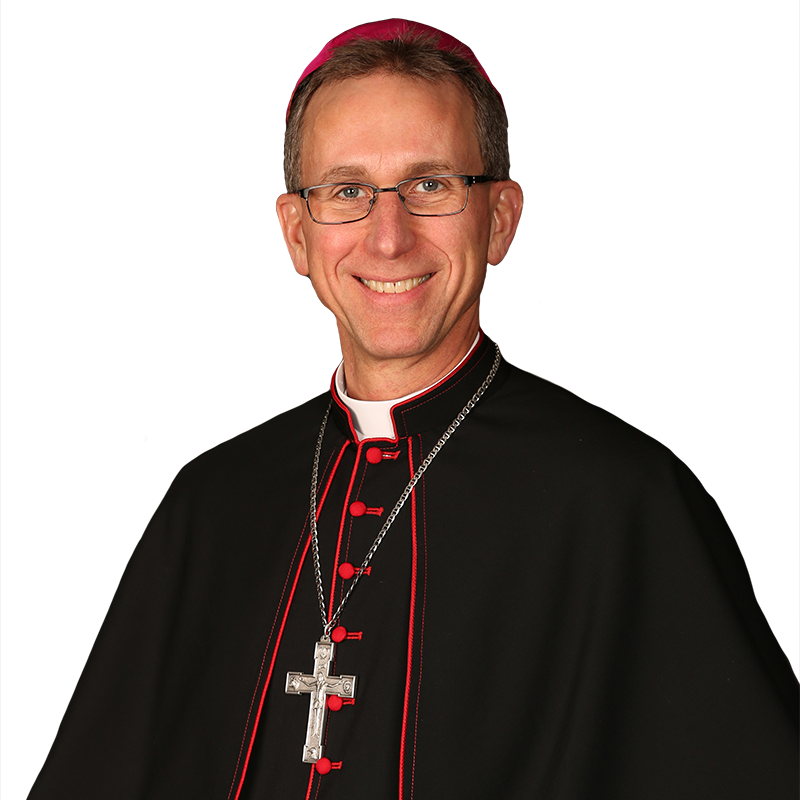
Most Rev. Paul J. Swain - Bishop of Sioux Falls
by Bishop Paul J. Swain - 4/2/2012
To all of you I bring greetings from His Holiness, Pope Benedict XVI. I, along with my brother bishops from Minnesota and the Dakotas, had the privilege of being received by him several weeks ago on our ad limina journey to the tombs of Peter and Paul.

People ask me how he is. My response is that I wish I had his vigor of mind and his serenity of faith at my age now, let alone at 85 which he will soon become. While I cannot say this about all Vatican officials, the Holy Father knows where South Dakota is.

One of the most moving experiences during that journey was to continue the tradition of bishops to gather over the tomb of St. Peter and proclaim the Profession of Faith, the successors of the Apostles reaffirming the faith that the first of the Apostles proclaimed in his own way for which he was martyred.

In reflecting on this moving moment, I wondered whether I am willing to die, if not physically, at least in popular esteem, by living the words we proclaimed. Sometimes Christ’s teachings are not popular or convenient and the result is ridicule even hate. There have been some harsh anti-Catholic attacks in our own media of late. However, what faith offers is the perspective to look beyond the moment to the life to come and to look at others with charity. When we live what we proclaim we are able to die to pride for which we will receive in return the serenity of faith that comes from being one with Christ.

There are two issues which are not popular or convenient that challenge us today, religious liberty and marriage and family life.

I discussed in the last Bulletin the federal government mandate to force institutions and individuals to provide and pay for abortion inducing drugs, sterilization and contraception by those who find them morally objectionable. The issue is freedom of religion and freedom of conscience though others seek to change the subject.

A recent statement by The United Conference of Catholic Bishops summaries the issue well: "We wish to clarify what this debate is—and is not—about. This is not about access to contraception, which is ubiquitous and inexpensive, even when it is not provided by the Church’s hand and with the Church’s funds. This is not about the religious freedom of Catholics only, but also of those who recognize that their cherished beliefs may be next on the block. This is not about the Bishops’ somehow “banning contraception,” when the U.S. Supreme Court took that issue off the table two generations ago. Indeed, this is not about the Church wanting to force anybody to do anything; it is instead about the federal government forcing the Church—consisting of its faithful and all but a few of its institutions—to act against Church teachings. This is not a matter of opposition to universal health care, which has been a concern of the Bishops’ Conference since 1919, virtually at its founding. This is not a fight we want or asked for, but one forced upon us by government on its own timing. Finally, this is not a Republican or Democratic, a conservative or liberal issue; it is an American issue."

I thank you for your support on this issue so far; sadly it will be with us for some time. Continue to pray, fast and contact public officials. We will not give up and we will not give in on something as fundamental to who we are as children of God and disciples of Christ. The salvation of souls is at stake.

On the issue of marriage and family life, Pope Benedict XVI in a discourse to bishops from the United States at which I was privileged to be present:

"It is in fact increasingly evident that a weakened appreciation of the indissolubility of the marriage covenant, and the widespread rejection of a responsible, mature sexual ethic grounded in the practice of chastity, have led to grave societal problems bearing an immense human and economic cost.

"Some of you have pointed with concern to the growing difficulties encountered in communicating the Church’s teaching on marriage and the family in its integrity, and to a decrease in the number or young people who approach the sacrament of matrimony. Certainly we must acknowledge deficiencies in the catechesis of recent decades which failed at times to communicate the rich heritage of Catholic teaching on marriage as a natural institution elevated by Christ to the dignity of a sacrament, the vocation of Christian spouses in society and in the Church, and the practice of marital chastity..."

Then he challenged us as parents and teachers: "young people need to encounter the Church’s teaching in its integrity, challenging and countercultural as that teaching may be; more importantly, they need to see it embodied by faithful married couples who bear convincing witness to its truth... young people need to be reassured that 'if we let Christ into our lives, we lose nothing, absolutely nothing, of what makes life free, beautiful and great.'”

St. Joseph, spouse of the Blessed Virgin Mary, help us to respond to the Pope’s challenge to teach the young the rich heritage of Catholic teaching, especially through the witness of faithful married couples, indeed through the faithful witness of all vocations, especially the priesthood.
We could easily get discouraged with these and all the other challenges of our day. However as we walk with Jesus on his journey to the cross and beyond this Holy Week, we can recommit to living the faith with integrity, receiving the Lord in the Holy Eucharist with regularity, praying with greater devotion to the Blessed Mother and St. Joseph, and trusting in God’s will and God’s way. The ultimate hope and encouragement of course we will celebrate on Easter: He is Risen, He is risen indeed.